When Heritage Meets Healthcare: Navigating Vaccine Conversations With Your Child's Doctor as a Southeast Asian Family

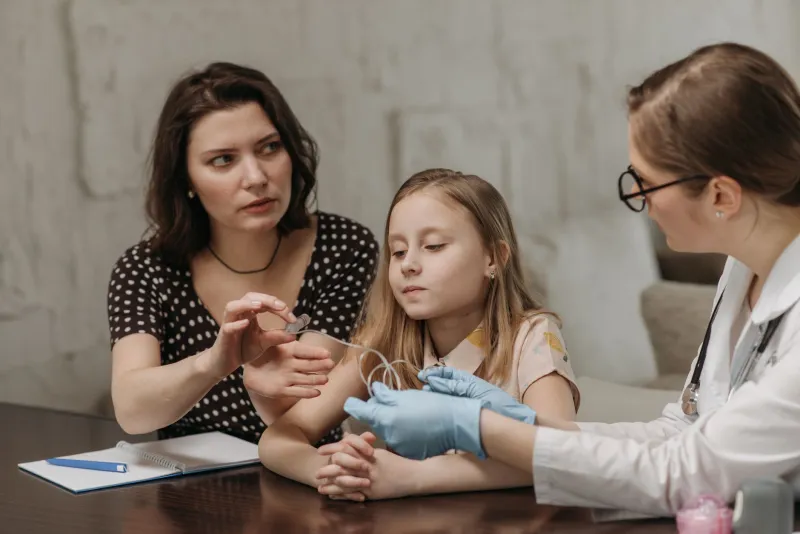
Photo: Southeast Asian mother talking with pediatrician during child checkup in US clinic, via c8.alamy.com
For Southeast Asian parents raising children in the United States, the pediatrician's office is often where two worlds quietly collide. On one side sits a physician armed with evidence-based immunization schedules and clinical data. On the other sits a parent carrying decades of family wisdom, perhaps a grandmother's remedy, a community elder's warning, or a deeply held spiritual framework around the body and illness. Neither perspective is without value — and yet the conversation between them rarely happens the way it should.
The silence in that exam room is not indifference. It is, more often than not, the product of uncertainty: uncertainty about how a doctor will respond to questions rooted in tradition, uncertainty about being judged, and uncertainty about whether raising a concern will be met with dismissal or genuine engagement. That silence, however, can carry real consequences for a child's health.
This article is about breaking it — thoughtfully, confidently, and on your own terms.
Why Cultural Beliefs About Health Are Not the Problem
It is worth stating clearly at the outset: holding traditional health beliefs does not make a parent irresponsible. Across Southeast Asia, systems of healing — from Ayurvedic-adjacent practices in parts of the region to Jamu herbal traditions in Indonesian communities, to spirit-based healing frameworks in Hmong culture — have served families for generations. These frameworks are not superstitions to be discarded; they are meaning-making systems that shape how families understand the body, illness, and protection.
When a parent asks whether a vaccine might "weaken" a child's natural defenses, or expresses concern that a newborn is "too young" to receive multiple injections at once, these questions often emerge from a coherent internal logic — one shaped by cultural narratives about strength, vulnerability, and care. Healthcare providers who dismiss these concerns outright lose the very opportunity they need to build trust.
For parents, understanding that your beliefs deserve to be heard — not just tolerated — is the first step toward a more productive conversation.
Before the Appointment: Preparing Your Questions
One of the most effective things a parent can do before a well-child visit is write down their concerns in plain language. Not medical jargon. Not hedged, apologetic phrasing. Just honest questions.
For example:
- "My mother told me that giving too many vaccines at once can overwhelm a baby's immune system. Can you explain how the schedule is designed with that in mind?"
- "In our family, we use herbal supplements regularly. Are there any interactions I should know about around the time of vaccination?"
- "I've heard from other parents in our community that certain vaccines caused reactions in their children. How common are those reactions, and what should I watch for?"
These are not provocations. They are legitimate inquiries. A good pediatrician will welcome them. If yours does not, that is itself important information about whether this provider is the right fit for your family.
During the Appointment: Strategies for Honest Dialogue
The exam room dynamic can be intimidating. Physicians, however well-meaning, often operate under time pressure, and parents may feel that raising cultural concerns will slow things down or cause friction. Here are several approaches that can help facilitate a more open exchange.
Lead with your goal, not your hesitation. Opening with "I want to make sure my child is protected, and I also have some questions about how this fits with our family's approach to health" frames the conversation as collaborative rather than oppositional. It signals to the provider that you are not refusing care — you are seeking understanding.
Use "I've heard" framing. Rather than stating a belief as absolute fact, presenting it as something you've encountered — "I've heard from others in our community that..." — invites the doctor to address it directly without triggering a defensive response on either side.
Ask for written or visual materials. Many parents process information better outside of a high-pressure clinical setting. Requesting brochures, reputable websites, or even asking the doctor to draw a diagram can help you engage with the information more fully at home.
Bring a trusted person. If language is a barrier or if you simply feel more comfortable with support, bringing a family member or community health worker as an interpreter or advocate is entirely appropriate. Some community health centers serving Southeast Asian populations can also help facilitate these conversations in culturally informed ways.
When You and Your Doctor Disagree
Sometimes, even after a respectful exchange, a genuine disagreement remains. A parent may still feel uncertain about a particular vaccine or schedule modification. In these situations, several options exist.
First, ask about the clinical flexibility in timing. Some vaccines on the recommended schedule have acceptable windows that allow for modest adjustments. A pediatrician who understands your concerns may be willing to work within those windows — not as a compromise of medical standards, but as an acknowledgment that building trust is itself a health outcome.
Second, request a second opinion. This is a right, not an insult. Seeking another provider who has experience working with immigrant or multicultural families may yield a different quality of conversation.
Third, consult resources designed for your community. Organizations serving Southeast Asian diaspora populations in the US — including community health workers, cultural liaisons at federally qualified health centers, and multilingual public health materials — can offer bridges between clinical guidance and cultural context.
What Healthcare Providers Should Know — and What You Can Tell Them
If your pediatrician seems unfamiliar with Southeast Asian health traditions or appears to minimize cultural concerns, it is appropriate to gently educate them. Statements like "In our community, there is a strong belief that..." or "My family practices [specific tradition], and I want to make sure you understand that context" are not overstepping. They are essential data points for a provider trying to offer you culturally competent care.
The field of medicine increasingly recognizes that vaccine hesitancy is not a monolith. It does not stem solely from misinformation or anti-science sentiment. For many Southeast Asian families, hesitancy is relational — it is about trust in institutions that have not always served immigrant communities well, about language barriers that make consent feel coerced rather than informed, and about a genuine desire to integrate the best of multiple health traditions rather than abandon one for another.
Healthcare providers who understand this are better equipped to serve families effectively. And parents who feel empowered to name these dynamics are better positioned to ensure their children receive the full protection that immunization offers.
The Goal Is the Same
At the center of every vaccine conversation — however complicated by culture, language, or history — is a shared objective: a healthy child. That common ground is not a small thing. It is, in fact, the most reliable foundation for the kind of dialogue that leads somewhere meaningful.
Your cultural heritage is not an obstacle to your child's healthcare. It is part of who your child is. A good healthcare relationship will find a way to honor that — and a well-prepared parent is the most powerful advocate for making that happen.